Form 26QB: TDS on sale of immovable property

Form 26QB: A Comprehensive Advisory On Tds For Immovable Property

When you buy a property in India worth ₹50 Lakhs or more, you aren’t just a buyer—you effectively become a “tax collector” for the government. To ensure transparency in real estate, the law shifts the responsibility of deducting tax (TDS) onto the buyer’s shoulders.

This process is completed using Form 26QB. Any lapse in timely or accurate compliance can attract a penalty of ₹200 per day, along with applicable interest. Whether you are a first-time homebuyer or a seasoned investor, understanding how to file Form 26QB accurately is the best way to ensure a smooth, penalty-free transaction. We break down everything you need to know to ensure your dream property doesn’t come with an unexpected tax headache.

What is Form 26QB

Form 26QB is an online, comprehensive “Challan-cum-Statement” used specifically for depositing Tax Deducted at Source (TDS) on the sale of immovable property.

Unlike traditional TDS filings (like Form 24Q or 26Q), which require the deductor to possess a Tax Deduction Account Number (TAN), Form 26QB is PAN-based. This ensures that individual buyers, who may only perform one or two property transactions in a lifetime, can comply with the law without the burden of obtaining and maintaining a TAN. It acts simultaneously as a payment voucher and a return of the tax deducted.

When is Form 26QB Required?

Compliance under Form 26QB is triggered based on specific statutory thresholds and conditions:

  1. Transaction Value: It is mandatory if the total sale consideration or the Stamp Duty Value (whichever is higher) is ₹50 Lakhs or more.
  2. Residential Status: It applies only when the Seller is a Resident of India. (Note: If the seller is an NRI, Section 195 applies, and the buyer must obtain a TAN.
  3. Asset Type: Applicable to all immovable property (residential, commercial, or land) except agricultural land.
  4. Timing of Filing: The form must be filed within 30 days from the end of the month in which the deduction was made.

Example: If you make a payment to the builder/seller on January 15th, you must file Form 26QB on or before March 2nd (30 days from the end of January).

The Proposed Insertion (Technical Detail)

Threshold for Joint Ownership: It is a common misconception that TDS is not applicable if an individual seller’s share is less than ₹50 Lakhs. However, the threshold of ₹50 Lakhs applies to the aggregate sale consideration of the property. For instance, if a property is sold for ₹90 Lakhs by two joint owners (50-50 share), TDS provisions under Section 194-IA are applicable to both sellers, even though their individual share is only ₹45 Lakhs. Each buyer must file a separate Form 26QB for each seller based on their respective share.

Details Required for Filing Form 26QB

To ensure an error-free filing—as corrections in Form 26QB can be technically cumbersome—the following information must be kept ready:

  1. Personal Information: PAN, Name, Residential Address, Email ID, and Mobile Number of both the Buyer and the Seller.
  2. Property Details: Complete address of the property, including the PIN code and type of property (Land or Building).
  3. Financial Details: * Total Agreed Sale Consideration.
    • Stamp Duty Value (SDV) of the property.
    • Date of the Agreement/Booking.
  4. Payment Details/Details of filing of form 26QB: * Date of Payment/Credit to the seller.
    • Whether the payment is in a lump sum (A single Form 26QB is filed at the time of the full payment or at the time of property registration.)
    • Whether the payment is in Installments. (A separate Form 26QB must be filed for every installment paid.)

Important Alert: The Impact of an Inoperative PAN

In the current tax regime, simply having a PAN card is not enough. Under Section 139AA, the seller must link their PAN with their Aadhaar.

  1. If the Seller’s PAN is “Inoperative”:
  2. Higher Tax Rate: The buyer is legally required to deduct TDS at a higher rate of 20% instead of the standard 1%.
  3. Compliance Risk: The buyer may receive a notice for “Short Deduction” if they deduct only 1% while the seller’s PAN status was inoperative in the Income Tax database at the time of the transaction.
  4. Credit Denied: The seller will not be able to claim credit for the tax deducted until the PAN is made operative.
  5. Professional Tip: Before executing the sale deed, the buyer should verify the PAN status of the seller on the Income Tax e-filing portal using the “Verify PAN” utility to ensure it is ‘Active and Operative.’

The Final Step: Issuing Form 16B (The TDS Certificate)

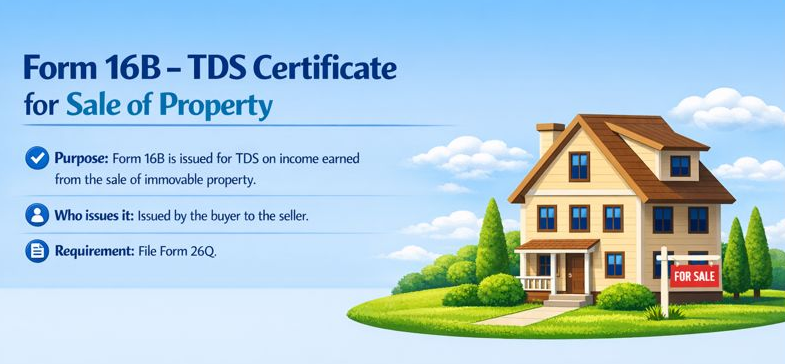
Form 16B is the TDS certificate issued to the seller as proof of tax deduction. It must be issued within 15 days from the due date of filing Form 26QB.

Failure to issue Form 16B attracts penalties under the Income-tax Act.

The Compliance Cycle:

  1. Deduction: Occurs at the time of payment/credit to the seller.
  2. Filing (Form 26QB): Within 30 days from the end of the month of deduction.
  3. Issuance (Form 16B): Within 15 days from the Form 26QB filing deadline.

Example: If a payment is made in 15th January, Form 26QB is due by March 2nd. Form 16B must then be shared with the seller by March 17th.

Penalties for the Buyer (Section 272A)

  • Daily Fine: A penalty of ₹100 per day applies for every day the certificate is delayed.
  • Maximum Limit: This penalty can go up to the total amount of TDS deducted for the transaction.

Transactional Friction: Beyond fines, the seller may legally withhold property possession or handover documents until they receive this certificate

Penalties and Interest: The Cost of Non-Compliance

  • The Income Tax Act prescribes a stringent interest and penalty regime for delays in TDS deduction, payment, or filing.


Type of Default Penalty / Interest Rate Section
Late Deduction 1% per month (from the date tax was deductible to the date of actual deduction). 201(1A)
Late Payment 1.5% per month (from the date of deduction to the date of actual payment). 201(1A)
Late Filing Fee ₹200 per day (from the due date until the form is filed, capped at the TDS amount). 234E
Non-Filing Penalty ₹10,000 to ₹1,00,000 (If not filed within one year from the due date). 271H

Common Practical Issues Faced by Buyers

  1. Multiple buyers or sellers requiring separate Form 26QB filings
  2. Incorrect PAN or property details
  3. Delay in Form 16B generation
  4. Mismatch in TDS credit in seller’s Form 26AS

Professional guidance ensures accurate compliance and avoids future disputes.

Why Professional CA Assistance Is Recommended

While Form 26QB appears simple, errors can result in penalties, interest, and litigation. A Chartered Accountant ensures:

  1. Correct applicability assessment
  2. Accurate computation and filing
  3. Timely issuance of Form 16B
  4. Rectification of errors and notices

Frequently Asked Questions (FAQs)

Q1: Is TDS applicable if the property is bought from an NRI?
No. If the seller is a Non-Resident Indian (NRI), Section 195 applies instead of Section 194-IA. In such cases, different rates apply and the buyer must have a TAN.
Q2: How is TDS calculated in the case of installment payments?
TDS must be deducted on every installment paid, not just the final payment. A separate Form 26QB must be filed for each payment made.
Q3: What if there are multiple buyers or sellers?
If there are joint parties, Form 26QB must be filled out for each unique buyer-seller combination for their respective shares.
Q4: Should TDS be calculated on the Stamp Duty Value or Purchase Price?
As per the latest amendments, TDS is calculated on the higher of the Actual Consideration or the Stamp Duty Value.
Q5: What happens if I deduct 1% TDS but the seller’s PAN is later found to be inoperative?
The Income Tax Department will treat this as a “Short Deduction.” As the buyer, you will be liable to pay the remaining 19% balance out of your own pocket, along with interest, before you can rectify the Form 26QB. Always verify the seller’s PAN status before making the payment.
Q6: Why does the Seller require Form 16B?
The seller needs it to prove the 1% was already paid so they don’t get taxed twice, and to ensure the credit reflects in their official tax records. This prevents the Income Tax Department from blocking their tax refunds due to “mismatched data.”
Q7: Is TDS applicable to the purchase of agricultural land?
No. Section 194-IA specifically excludes rural agricultural land. However, urban agricultural land may still attract TDS.


Services We Offer

Jitesh Telisara & Associates LLP, CA In Pune is a professionally managed firm catering to domestic and international clients with a broad range of services in domestic and international taxation, regulatory and advisory services and crosses border transaction-related services.

The team at the firm has dedicated and experienced professionals and associates like Chartered Accountants, Company Secretary and Consultants to provide end to end services to your business. With the effort of gaining a deep understanding of your business, the team is committed to providing valuable, consistent and efficient services based on its in-depth knowledge and wide experience in the areas of audit, taxation, regulatory compliances, and related business services.