List of Documents required for GST Registration in India

List of Documents Required for GST Registration in India

Starting a new venture is an exciting milestone, but before you can issue your first tax invoice, you need to navigate the GST registration process. Getting your GST registration right from the start is more than just a legal requirement—it’s the foundation of your business’s financial credibility.

Goods and Services Tax (GST) registration is a mandatory compliance requirement for eligible businesses under the Central Goods and Services Tax Act, 2017. To ensure a smooth and error-free GST registration, submitting accurate and complete documentation is critical. One of the biggest reasons applications get rejected is “document deficiency.”

This guide provides a comprehensive, legally accurate list of documents required for GST registration, categorised by business structure, along with professional insights to help applicants avoid delays, rejections, or compliance risks. Whether you are a solo freelancer or a growing private limited company, the requirements vary.

Importance of Proper Documents required for GST registration

The GST authorities verify identity, business constitution, and place of business before granting registration. Incomplete or incorrect documents may result in:

  1. Application rejection or queries (Form GST REG-03)
  2. Delayed GSTIN allotment
  3. Future compliance and audit complications

Universal Documentation Requirements: The Foundation of Your GST

Application

While specific entity types (like Companies or LLPs) have unique requirements, the GST portal mandates a “General Toolkit” of documents that apply to every applicant. Accuracy here is non-negotiable to prevent preliminary rejection by the GST Officer.

Identity and Jurisdictional Proofs

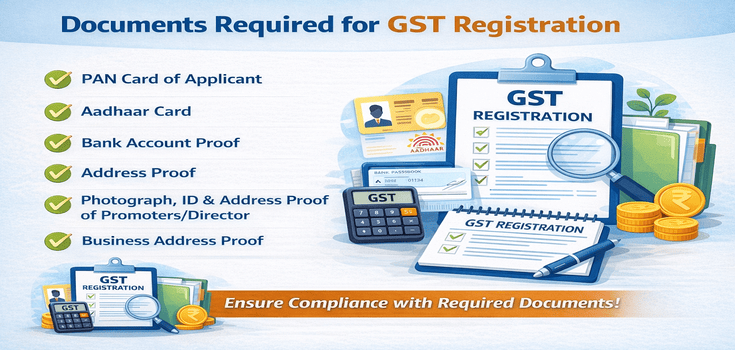
Every applicant, whether an individual or a corporate entity, must provide the following Property Scanned copies for KYC verification:

  1. Permanent Account Number (PAN): The fundamental identifier for the business. All GSTINs are PAN-linked.
  2. Aadhaar Credentials: Required for the primary authorised signatory and promoters. Note: Aadhaar-linked mobile numbers are essential for seamless e-verification.
  3. Passport-Sized Photographs: Clear, high-resolution JPEG images of the applicant or authorised representatives.
  4. Foreign Nationals: For overseas directors or partners, a valid Passport is mandatory. If the document is in a foreign language, it must be translated into English and notarised.

Evidence of Business Premises (Place of Business)

The GST department requires conclusive proof of the location where business activities are conducted. The documentation depends on the legal relationship with the property:

Ownership-Based Evidence (Self-Owned)

If the applicant or the business entity (Company/LLP) holds legal title to the property, the following documents serve as conclusive proof of possession. Using multiple documents from this list strengthens the application:

  1. Latest Electricity Bill: This is the most preferred document by GST officers. It must not be older than two months from the date of application. Ensure the name on the bill exactly matches the name on the ownership deed or the applicant’s name.
  2. Property Tax Receipt / Municipal Khata: A copy of the most recent property tax payment receipt or the Khata certificate acts as a secondary layer of verification of the property’s existence and the owner’s legitimacy.

Occupancy-Based Evidence (Rented or Leased)

If the business operates from a rented facility, the following “Dual-Document” verification is required:

  1. Valid Rent/Lease Agreement: The agreement must be current (not expired) and duly signed by both the Landlord (Lessor) and the Tenant (Lessee).Advisory Note: Ensure the agreement is registered as per State laws. For long-term leases, a registered lease deed is often preferred by the department.
  2. Supporting Ownership Proof of Landlord: Along with the rent agreement, you must upload the landlord’s ownership document (typically a recent Electricity Bill or Property Tax Receipt). The portal requires this to verify that the person leasing the property to you has the legal authority to do so.

Specialised Requirements for Shared / Consented Premises

In scenarios where the business operates from a location without a formal rental agreement—typically a property owned by a relative, director, or friend—the GST law requires a specific set of “Consent-Based” documentation.

To satisfy the GST officer of your right to use the premises, you must provide:

  1. No Objection Certificate (NOC): A formal written declaration issued by the legal owner of the property, explicitly stating that the owner has no objection to the applicant utilizing the premises for business purposes and obtaining a GST registration at the specified address. To ensure the validity of the declaration and facilitate signature verification by the GST authorities, a self-attested copy of the property owner’s Permanent Account Number (PAN) card must be attached as a mandatory supporting document.
  2. Proof of Ownership by the Executant: The NOC alone is insufficient. It must be accompanied by a document proving that the individual signing the NOC actually owns the property. Acceptable proofs include:
    • A copy of the Electricity Bill (ensure the name matches the NOC signatory).
    • Property Tax Receipt or Municipal Khata.

Documents Required for GST Registration – Business Structure Wise

Individual / Sole Proprietorship

This is the simplest form of business. Interestingly, you don’t need a separate tax identity for the business; your personal identity suffices.

  1. Identity Proof: PAN Card and Aadhaar Card of the proprietor.
  2. Address Proof: Documents for your place of business (as stated above)

Pro Tip: In a proprietorship, your personal PAN serves as your business PAN; however, if the business operates under a trade name distinct from the individual’s legal name, it is mandatory to provide supporting regulatory evidence such as a Shop and Establishment Act Registration (Shop Act) or an MSME/Udyam Registration. These documents serve as statutory proof linking the individual’s PAN to the specific trade name, ensuring legal consistency and compliance for GST registration and banking purposes.

Partnership Firms & LLPs

Because these involve multiple stakeholders, the government requires proof of the agreement between partners.

  1. Legal Documents: PAN Card of the Firm/LLP and the Partnership Deed (or LLP Agreement).
  2. Partner Details: PAN and Aadhaar for all partners or designated partners, along with address and the Electricity bill for the place of residence.
  3. Authorisation: A letter identifying the “Authorised Signatory” (the person who will sign the GST filings).
  4. Business Address: Proof of your principal place of operation. (as stated in the above section)

Private Limited / Public Limited Companies

Companies are separate legal entities, so the documentation is more rigorous to ensure corporate compliance.

  1. Constitution Docs: Certificate of Incorporation, along with the MOA (Memorandum of Association) and AOA (Articles of Association).
  2. Entity Identity: PAN Card of the company.
  3. Director Details: PAN and Aadhaar of all directors, along with address and the Electricity bill for the place of residence.
  4. Board Resolution: A formal document from the board authorising the GST registration and appointing a signatory.
  5. Location: Address proof of the registered office

HUF (Hindu Undivided Family) & Trusts/Societies

  1. For HUF: You’ll need the HUF’s PAN, the Karta’s (head of family) PAN and Aadhaar, and business address proof.
  2. For Trusts/Societies: The Registration Certificate or Trust Deed, along with the PAN and Aadhaar of the managing committee members.

Common Pitfalls: Why GST Applications Gets Rejected

Even with all the documents, small errors can lead to rejection. Watch out for:

  1. Name Mismatches: The First Name, Middle Name, and Last Name submitted in the application must match the data recorded on your PAN exactly. Furthermore, ensure the name on your PAN corresponds perfectly with the name on your Aadhaar, as even a minor spelling mistake or character discrepancy can trigger a “data mismatch” error, leading to the rejection of the application during the automated validation or e-KYC process.
  2. Existence of Difference Trade Name: If you have a Trade name for your business, you must provide a Shop & Establishment Act License (Shop Act/Gumasta) or a Trade License issued by your local Municipal Corporation. This certificate serves as the “Birth Certificate” of your trade name.
  3. Expired Proofs: Using an electricity bill or rent agreement that is more than two months old is a common reason for rejection.
  4. Blurry Uploads: If the tax officer can’t read the address on your Electricity bill, they will reject the application. Ensure all scans are clear and legible.
  5. For Maharashtra-based GST registrations, obtaining a Professional Tax Enrollment Certificate (PTEC) is mandatory for the entity/proprietor to pay their own professional tax. In contrast, a Professional Tax Registration Certificate (PTRC) is only required if the business has employees, as it is used to deduct and remit tax from their salaries.

A professional review significantly reduces the risk of GST registration rejection

Frequently Asked Questions (FAQs)

Q1. Is Aadhaar mandatory for GST registration?
No. Aadhaar authentication is mandatory for most applicants. But Failure to provide an Aadhar number may result in physical verification for the application. After Physical verification is successfully completed, the final ARN (Application reference number) is generated
Q2. Can I apply for GST registration without a bank account?
Bank account details are not mandatory at the time of initial application, but they are mandatory for post-registration compliance. Bank details must be updated within 30 days after registration.
Q3. Can I use my residential address as my GST-registered office?
Yes, you can register your business at your residential address, provided you are the owner of the property and you have the necessary address proof (like an electricity bill) and property tax receipt for the property. In case the property is owned by any of your acquaintance, a consent letter from the owner along with their Pan is required. A rented residential home cannot be used for GST registration.
Q4. Is rent agreement compulsory for Commercial rented premises?
Yes. A valid rent or lease agreement is mandatory for a Commercial rental space. Please note a residential premises is not eligible to be used for GST registration.
Q5. How long does GST registration approval take?
Typically 3–7 working days if documents are complete and accurate.
Q6. Can multiple businesses use the same address for GST registration?
Yes, provided valid address proof and proper authorization are submitted.
Q7. Is it mandatory to have a separate bank account for GST registration?
For companies and LLPs, yes. For sole proprietors, you can initially use your personal savings account, but we highly recommend opening a current account in the business name as soon as the registration is granted. Bank details need to be updated within 30 days of the generation of GST certificate.
Q9. Is a Shop Act required for a home-based business trade name?
Yes. Even if you operate from home, most states require a “Residential Shop Act” or “Intimation” to legally use a professional trade name for your consultancy or e-commerce venture. Alternatively, an MSME (Udyam) Registration Certificate can also be utilized as statutory proof to establish and validate your trade name for GST and banking purposes
Q8. Can my Trade Name be different from my Legal Name?
Yes. Your Legal Name must match your PAN (e.g., your personal name for a proprietorship). However, your Trade Name can be your brand. To do this, the Shop Act License is essential as it acts as the legal proof that the individual is “trading as” (T/A) the brand name.


Services We Offer

Jitesh Telisara & Associates LLP, CA Kharadi is a professionally managed firm catering to domestic and international clients with a broad range of services in domestic and international taxation, regulatory and advisory services and crosses border transaction-related services.

The team at the firm has dedicated and experienced professionals and associates like Chartered Accountants, Company Secretary and Consultants to provide end to end services to your business. With the effort of gaining a deep understanding of your business, the team is committed to providing valuable, consistent and efficient services based on its in-depth knowledge and wide experience in the areas of audit, taxation, regulatory compliances, and related business services.