1. Is it possible to revise an Income Tax Return (ITR) that was filed after the due date?
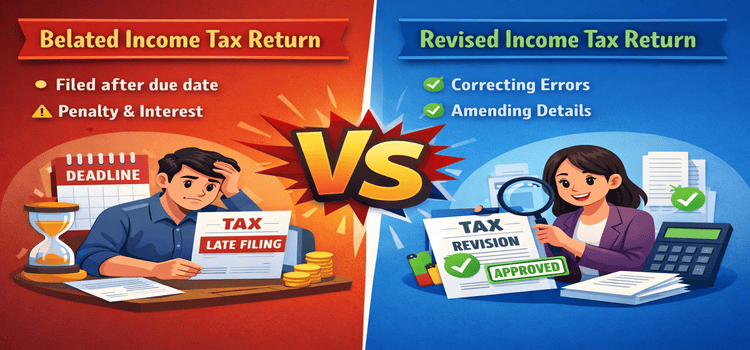
Yes. Under the provisions of Section 139(5) of the Income-tax Act, 1961, any return filed under Section 139(1) (Original) or Section 139(4) (Belated) can be revised. If you discover any omission or wrong statement in your belated filing, you may furnish a revised return within the prescribed statutory timelines.
2. What is the deadline for filing a revised return for FY 2025-26 (AY 2026-27)?
For the Assessment Year 2026-27, a revised return can be filed at any time on or before 31st March 2027, or before the completion of the assessment by the Department, whichever is earlier. It is pertinent to note that while the window for a belated return closes on 31st December 2026, the law provides an additional window until March for revisions provided original or belated return has been filed before 31st December 2026
3. Will I be charged a penalty for revising my ITR?
There is no specific “revision penalty.” However, the financial implications depend on the timing and nature of the original filing:
Original filed on time: No late filing fee under Section 234F.
Original was belated: The late filing fee (up to ₹5,000) paid during the belated filing remains applicable.
Post-December Revision: Under the updated 2026 provisions, revisions made between January 1st and March 31st may attract a late filing fee if not already discharged.
Increased Liability: If the revision results in higher taxable income, additional interest under Sections 234A, 234B, or 234C may apply.
4. Can I carry forward business losses if I revise a belated return?
No. While you can revise a belated return to correct errors, the revision does not override the consequences of the initial delay. Under Section 139(3), business losses and capital losses can only be carried forward if the original return was filed within the due date prescribed under Section 139(1). The only exception is Loss from House Property, which can be carried forward even if the return was belated or revised.
5. How many times can a taxpayer revise their return?
The Income-tax Act does not specify a limit on the number of times a return can be revised. A taxpayer can file a revised return multiple times, provided each subsequent revision is filed within the allowed timeframe (i.e., before March 31st of the relevant AY or completion of assessment). Each new revised return replaces the previous one entirely.
6. What happens to the original return once a revised return is filed?
Once a revised return is filed under Section 139(5), the original return (or the previous belated/revised return) is deemed to be withdrawn and substituted by the revised version. The Income Tax Department will process the latest return filed, treating it as the final and valid disclosure of your income for that financial year.