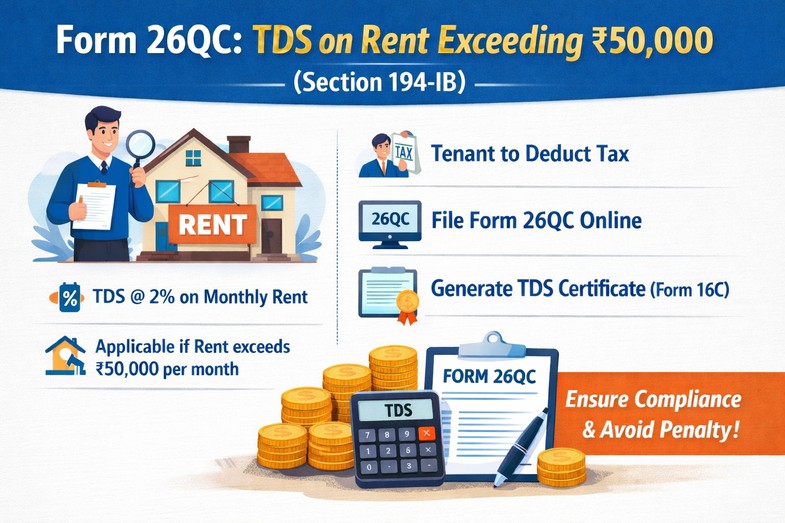
With the rising costs of luxury housing and commercial spaces in metro cities, many individuals find themselves paying monthly rents exceeding ₹50,000. Under the Income Tax Act, such payments trigger specific Tax Deducted at Source (TDS) obligations under Section 194-IB. Unlike corporate tenants, individual tenants often lack a Tax Deduction Account Number (TAN), which is where Form 26QC—a specialized challan-cum-statement—comes into play.
In this guide, we break down the latest compliance requirements to help you avoid interest and penal consequences.
What is Section 194-IB?
Section 194-IB mandates that any Individual or Hindu Undivided Family (HUF)—who is not liable for a Tax Audit under Section 44AB—must deduct tax at source if they pay rent to a resident Indian exceeding ₹50,000 per month (or part of a month).
Key Statutory Features:
- No TAN Required: Tenants can fulfil this obligation using only their Permanent Account Number (PAN).
- Scope of “Rent”: Includes payments for the use of land, buildings (residential or commercial), furniture, and fittings.
Updated TDS Rates (Post-October 2024)
The Union Budget 2024 introduced a significant rationalisation of TDS rates. As a deductor, you must be aware of the applicable rate based on the date of deduction:
| Period of Rent Credit/Payment | Applicable TDS Rate |
| Up to September 30, 2024 | 5% |
| From October 1, 2024, onwards | 2% |
| If the landlord’s pan is Inoperative | 20% (Capped at last month’s rent) |
Information Required for Form 26QC TDS on Rent Exceeding ₹50,000
Before you begin the filing process, ensure you have the following details at your fingertips. Providing accurate data is vital, as any errors in PAN or payment amounts can lead to complex correction procedures on the TRACES portal.
1. Personal & Contact Information
- PAN of the Tenant: Your Permanent Account Number.
- PAN of the Landlord: Ensure this is verified and active.
- Full Names: As per the PAN cards of both parties.
- Contact Details: Valid mobile numbers and email IDs for both the tenant and landlord
- Residential Addresses: Complete current addresses for both the payer and the receiver.
2. Property & Tenancy Particulars
- Premises Address: The full postal address of the rented property.
- Type of Property: Clearly specify whether the asset is Land, a Building, or both.
- Tenancy Duration: The exact start and end dates as per your registered rent agreement.
- Period of Months: The total number of months covered in the current financial year or the specific tenancy period.
3. Financial & Transactional Details
- Rent Value: Total rent payable for the entire period.
- Last Month’s Rent: The specific amount paid for the final month of the year or tenancy.
- TDS Amount: The calculated tax to be withheld (2% or 20% in case PAN is inoperative).
- Dates of Transaction: * Date of credit/payment to the landlord.Date of actual tax deduction.
Compliance Timeline for Form 26QC
The process of reporting and paying this tax is consolidated into Form 26QC.
When to Deduct?
The law provides for a once-a-year compliance. Tax should be deducted at the earlier of:
- The end of the Financial Year (March 31st).
- The last month of the tenancy (if the property is vacated mid-year).
Who should deduct TDS?
A tenant must deduct TDS from their house rent if the rental amount is Rs 50,000 or more for a month or part of it.
Due Date for Filing & Payment
Form 26QC must be filed electronically within 30 days from the end of the month in which the deduction was made.
- Example: If you deduct tax on March 31, 2026, you must file Form 26QC and pay the tax by April 30, 2026.
Issuance of Form 16C
After filing Form 26QC, the tenant is legally obligated to provide the landlord with a TDS certificate in Form 16C.
- Source: Downloaded from the TRACES portal.
- Timeline: Within 15 days from the due date of filing Form 26QC.
Consequences of Non-Compliance
As practising professionals, we observe that the Income Tax Department frequently issues notices for defaults under this section. The penalties are structured as follows:
- Late Filing Fee (Sec 234E): ₹200 for every day of delay in filing Form 26QC, which is restricted to the TDS amount.
Example – If you file Form 26QC with a delay of 100 days for a TDS amount of ₹15,000, the calculated late fee of ₹20,000 (100 days × ₹200) will be restricted to a maximum of ₹15,000, as the fee under Section 234E cannot exceed the total TDS amount deductible. - Interest on Late Deduction: 1% per month from the date the tax was deductible.
- Interest on Late Payment: 1.5% per month from the date of deduction to the actual date of payment.
- Penalty (Sec 271H): A penalty ranging from ₹10,000 to ₹1,00,000 may be levied for continued non-filing.
Distinguishing Section 194-I from Section 194-IB:
While both provisions govern Tax Deducted at Source (TDS) on rental payments, they are designed for distinct groups of taxpayers and involve separate compliance procedures. Understanding these differences is vital to avoid being classified as an “Assessee-in-Default” by the Income Tax Department.
Defining the Two Compliance Scenarios
Category 1: Standard TDS under Section 194-I
This section applies to established businesses and high-turnover individuals. You fall into this category if you are:
- Corporate & Formal Entities: This includes Companies, LLPs, Partnership Firms, and similar organizations.
- Audit-Liable Individuals/HUFs: Any individual or HUF whose business turnover exceeded ₹1 Crore or whose professional receipts were over ₹50 Lakh in the previous financial year.
Category 2: Simplified TDS under Section 194-IB (Using Form 26QC)
This section targets individual tenants who pay high-value rent but do not have a business audit requirement. You fall here if:
- Non-Audit Individuals/HUFs: You are a salaried employee or a smaller business owner whose turnover/receipts fall below the audit thresholds mentioned above.
- The Threshold: This applies only if your monthly rent exceeds ₹50,000.
Comparative Summary Table
|
Feature |
Section 194-I (Standard TDS) | Section 194-IB (Form 26QC) |
| Payer/Tenant Profile | Companies, Firms, and Individuals/HUFs under Tax Audit (Sec 44AB). | Individuals/HUFs not liable for Tax Audit. |
| Primary Form Used | Form 26Q (Quarterly Return). | Form 26QC (Challan-cum-Statement). |
| TAN Requirement | Mandatory (Tax Deduction Account Number). | Not Required (PAN-based filing). |
| TDS Rate (Buildings) | 10% | 2% (Post-Oct 1, 2024). |
| Compliance Frequency | Monthly deduction; Quarterly filing. | Annual deduction; One-time filing. |
| Certificate Issued | Form 16A. | Form 16C. |
Payment Timeline Variance
- Section 194-I: Tax must be deposited by the 7th of the following month (except for March, which is April 30th).
- Section 194-IB: Tax must be deposited within 30 days from the end of the month in which the deduction is made (typically once a year).