Income Tax Act, 1961 of India applies to all persons having income earned or accrued in India. However, its applicability differs basis the residential status of a person. The residential status as stated in Income Tax Act should not be considered as a synonym for citizenship of India.

CBDT introduced a new section in the Income Tax Act, w.e.f.1st September 2019, to bring in transactions of cash withdrawals under the tax net. According to Section 194N, all the Banks to which Banking Regulation Act applies, a Co-operative Society and a post office shall be responsible to deduct TDS, if any person withdraws cash from the account/s maintained with them, being the amount or aggregate of amounts exceeding rupees one crore during the financial year.

Income Tax Act has broadly defined taxability of income under five heads of Income. One of them is Capital Gain, where gains arising out of sale of capital assets are taxable in the hands of the seller of the capital asset. However, with the intention of tax evasion, assesses started entering into an agreement with the buyer, where the sale value declared by the seller is less than the actual sale consideration. This led to loss of tax to the government, and thus to avoid this, section 50C and Section 56 (2)(x) was introduced as two sides of a coin. Section 50C states taxability of such cases in the hands of the seller while Section 56 (2)(x) specifies about the taxability of such transactions in the hands of the buyer.
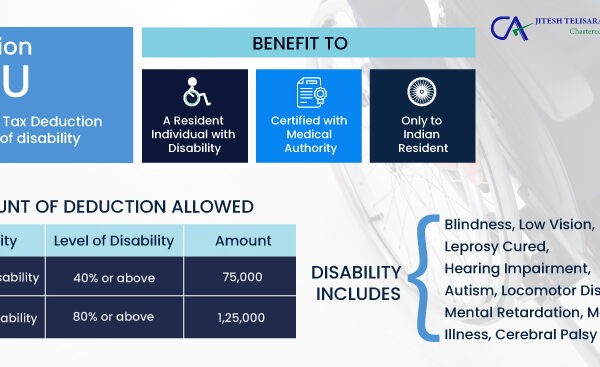
Whenever we come across an individual who is suffering from disabilities, the first reaction of most people is to pity them. However, it should not be the case. There are many stories of individuals who, despite suffering from disabilities, have soared the heights of success.

When the Goods and Service Tax Act was introduced, there were many doubts and clarifications were raised by industries as to what falls within the ambit of GST and what does not? GST is levied and applicable to the supply of goods and services.

Ministry of Corporate Affairs has introduced DIR-3 e-KYC to conduct KYC verification for all the persons who have been allotted DIN (Director Identification Number). DIN is a unique 8 digit number allotted to a person who wishes to become a director of a company. Thus any person who holds a DIN is mandatorily required to file DIR-3 KYC with MCA.

In today’s times, getting a higher education has become a point of concern where the fees for such education are touching the sky. As they say, the only thing costlier than education is ignorance.

It is always advised to everyone that better be safe than worry. It applies not just for health but also financial requirements for health. Thus, health insurance, popularly known as medical insurance is an important and mandatory investment in your investment portfolio. To encourage this investment, government provides tax benefits in the form of deduction of the investment made in medical insurance. This tax benefit is over and above of the investments stated under Section 80C/CC/CCD and is claimed under section 80D.

In order to promote digital financial transactions and curb cash transactions, the government has introduced Section 194N in the Union Budget of 2019. This section is further amended by the Finance Act 2020, where tax has been imposed in the form of TDS on cash withdrawal above Rs 1 crore by any taxpayer.

Our finance minister had announced in the Union Budget that a facility for an instant e-PAN shall be launched. Accordingly, this facility has been launched and available where taxpayers can apply for PAN basis the Adhaar they hold. Through this facility, applicants can apply and get PAN immediately and free of cost.